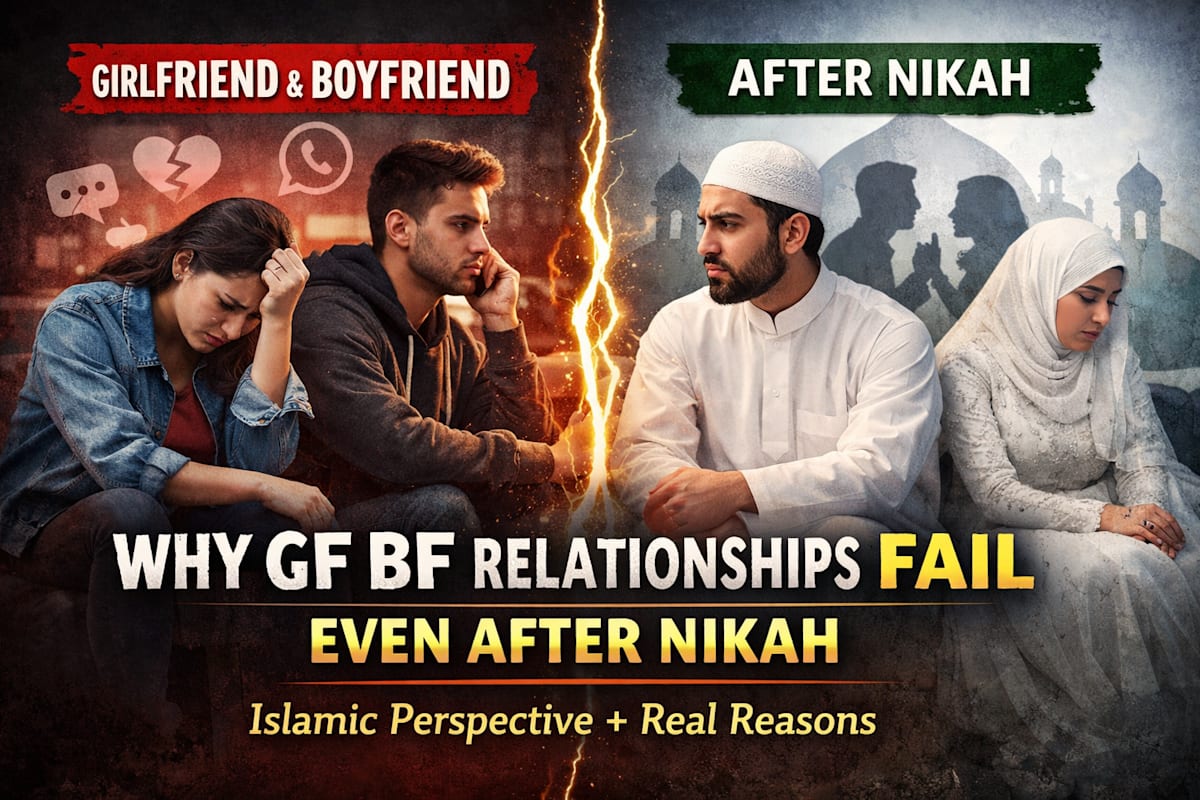
Why Modern GF–BF Relationships Often Fail, Even When They End in Nikah (Islamic + Philosophical Analysis)
In many Muslim societies today, GF–BF relationships have become normalized under modern labels: “talking stage,” “getting to know each other,” “exclusive,” “situationship,” or “serious relationship.” Many people justify it by saying, “We’re not doing zina,” or “We plan to marry anyway.” The assumption is simple: if the relationship ends in nikah, then the earlier phase was only a harmless step toward something halal. But the lived reality is often the opposite. Many marriages that begin as emotionally intense GF–BF relationships either collapse soon after nikah or continue as emotionally exhausted unions with hidden resentment, insecurity, and loss of respect.
From an Islamic perspective, the issue is not only about legality. It is about psychology, spiritual consequence, and the kind of character a relationship produces. Islam does not merely prohibit zina; it blocks the roads that lead to it. The Qur’an does not say, “Do not commit zina,” alone it says, “Do not even come near zina.” This is a deep moral philosophy. It means the believer must not build emotional and physical closeness through a path that trains the soul to ignore boundaries. When a relationship begins with disobedience, secrecy, and unchecked intimacy, it forms a pattern: love becomes attached to transgression. Even if the couple later makes it halal through nikah, the relationship often carries the same “spirit” the same habits of emotional consumption, entitlement, and boundary violation.
The First Hidden Problem: A Relationship Without Sacred Boundaries Creates a Culture of Entitlement
GF–BF relationships often start with the feeling that two people are “free” to define their own rules. This sounds romantic, but psychologically it is dangerous. In Islam, boundaries are not obstacles; they are protection. When boundaries are removed, intimacy grows faster than character. The relationship becomes emotionally intense before it becomes ethically mature. This creates entitlement: the belief that because someone gives you emotional closeness, you have the right to their time, attention, and loyalty even without formal responsibility.
In a halal framework, nikah is not just a ceremony; it is a moral contract. It gives intimacy structure and dignity. But in GF–BF dynamics, intimacy often comes first, and responsibility is promised later. This reverses the natural order. It trains the mind to believe that love is proven by access to someone’s emotions, privacy, body, and time. Later, when nikah arrives, the couple often struggles because the relationship was built on emotional consumption, not on discipline. The marriage becomes less about mercy and more about “What are you giving me?”
Emotional Dominance: When Love Turns Into Control
One of the most common patterns in GF–BF relationships is emotional dominance. It rarely appears as obvious abuse at the start. It often begins subtly: one partner becomes the emotional center, and the other becomes emotionally dependent. Over time, the relationship becomes a system of control where affection is used as currency. Love is given and withdrawn to shape behavior. Silence becomes punishment. Anger becomes leverage. Jealousy becomes a tool.
This dynamic is common because the relationship has no formal accountability. There is no wali, no family presence, no social structure to restrain impulsive behavior. The result is that many people unconsciously act on their insecurities. They “test” loyalty. They demand constant reassurance. They interpret small delays in replies as betrayal. The relationship becomes exhausting long before marriage.
Philosophically, emotional dominance is a sign that the relationship is not rooted in love, but in fear. Love that requires control is not love; it is anxiety disguised as intimacy. Islam seeks to produce sakoon (tranquility) in marriage. A relationship that trains the nervous system for constant insecurity cannot suddenly become peaceful after nikah.
Disrespect: The Silent Poison That Usually Begins Before Marriage
Many couples believe their relationship is strong because they have passion, deep conversations, and emotional intensity. But what truly predicts marital success is not passion it is respect. GF–BF relationships often weaken respect early because they normalize behavior that would never be tolerated in a halal engagement. People tolerate harsh words because they fear losing the person. They accept humiliation because they are emotionally attached. They allow “jokes” that degrade them because they want to appear easygoing. They forgive repeated boundary-crossing because they want to keep the relationship alive.
Over time, disrespect becomes a language. It becomes normal to raise voices, to mock, to accuse, to insult, to threaten leaving. Many relationships survive these behaviors only because the couple is addicted to the emotional highs and lows. But when nikah happens, the same disrespect continues now with greater consequences. Marriage does not magically teach a person adab (proper conduct). If someone trained themselves to speak without respect before nikah, they will usually speak the same way after nikah.
Islam emphasizes adab because it protects the dignity of both spouses. A marriage without dignity becomes a prison even if love exists.
Devaluation After Nikah: When the Chase Ends, the Reality Begins
A painful truth is that many people are valued most in the relationship stage and less after nikah. This is not because the person became less worthy, but because the relationship was driven by pursuit, thrill, and emotional excitement. GF–BF relationships often carry the “forbidden thrill” effect. The secrecy, the private calls, the emotional intensity, the feeling of breaking rules these produce dopamine. This is a psychological reality, not just a religious claim.
When nikah happens, the relationship becomes normal. The thrill fades. Responsibilities appear. Family expectations arrive. Daily life begins. Some people experience a sharp emotional drop and interpret it as “falling out of love.” Then devaluation begins: they become colder, less appreciative, less affectionate. They start criticizing flaws they ignored before. They become impatient. They compare their spouse with others. They miss the “old version” of the relationship.
Philosophically, this reveals that the earlier love was not rooted in commitment. It was rooted in stimulation. And stimulation cannot sustain a marriage. Islam builds marriage on mercy and responsibility precisely because emotions fluctuate. A relationship built mainly on emotion becomes unstable the moment emotions change.
Crossed Boundaries Create Long-Term Trust Problems
Even if a couple never committed zina, GF–BF relationships usually involve crossing boundaries: private conversations, emotional dependence, secrecy from family, and intimacy without structure. The psychological effect of this is severe. The mind learns that love is something you take privately, not something you honor publicly. This creates a hidden wound: the relationship begins with secrecy and survives through secrecy.
Later, after nikah, the couple may face a new type of insecurity: If we broke boundaries before, what stops us from breaking them again? This is especially damaging in modern life where social media and messaging make private connections easy. A spouse may become overly suspicious, constantly checking phones, doubting friendships, interpreting normal interactions as threats. This can destroy the marriage even if both partners are sincere.
Islam prevents this by insisting on modesty and accountability before marriage. It protects trust by protecting the environment in which trust grows.
The Fantasy Problem: People Fall in Love With a Curated Version
GF–BF relationships are often lived in a controlled environment. Meetings are planned. Conversations are intentional. Both partners present their best selves. Even when they share vulnerabilities, they often share them in a romanticized way. But marriage exposes the full human being: stress, fatigue, financial pressure, family responsibilities, moods, and daily habits.
Many couples discover after nikah that they did not truly know each other. They knew each other’s emotional stories, but not their character under pressure. They knew each other’s dreams, but not their discipline. They knew each other’s affection, but not their patience.
Islamic courtship is not meant to be emotionally limitless. It is meant to be structured so that compatibility is assessed without emotional addiction. Because emotional addiction blinds judgment. When people become attached, they start justifying red flags. They start calling disrespect “passion.” They start calling jealousy “love.” They start calling control “care.”
Philosophically, this is the tragedy of modern romance: it confuses intensity with truth.
Modern Comparison Culture: Too Many Options, Too Little Contentment
Today’s relationships are not competing only with other people. They are competing with an entire digital fantasy. Social media constantly shows:
- perfect couples
- romantic trips
- aesthetic gifts
- scripted affection
- “soft life” illusions
This creates a subconscious dissatisfaction. Even when someone marries the person they loved, they may still feel they could have had better. GF–BF relationships often worsen this because they train people to be driven by emotion rather than by principles. When emotion is the primary guide, the person becomes vulnerable to comparison.
Islam teaches contentment and lowering the gaze not because desire is evil, but because desire without discipline becomes destructive. A heart that is constantly comparing cannot remain loyal in a meaningful way.
When Love Begins as Need, Marriage Becomes Burden
Many GF–BF relationships begin not from maturity but from loneliness. People enter relationships to feel valued, to escape sadness, to fill emptiness, or to heal wounds. They confuse emotional relief with love. The relationship becomes a psychological medicine. But marriage is not medicine. Marriage is responsibility.
When the relationship becomes halal through nikah, the emotional “high” is replaced by daily obligations. The person who was using the relationship to feel alive now feels trapped. They start resenting their spouse for not providing constant excitement. They may accuse their spouse of changing, when in reality the relationship simply moved from fantasy to reality.
Islamic marriage is not designed to entertain you. It is designed to stabilize you. And stability requires maturity.
Spiritual Consequences: Barakah Is Not a Metaphor
Many people treat barakah as a vague religious idea. But in Islamic philosophy, barakah is real. It is the unseen assistance of Allah that brings ease, growth, and stability. When a relationship begins in disobedience, the couple may still experience emotional pleasure — but pleasure is not proof of barakah. Haram can feel sweet in the beginning. That sweetness is often a test.
A relationship that begins by ignoring Allah often develops spiritual weakness. People begin to justify sins. They become casual about modesty. They become less sensitive to wrongdoing. They may pray less, or feel hypocrisy, or distance themselves from religious reminders because it creates guilt. Over time, the relationship becomes not just a romantic bond but a spiritual distraction.
Even after nikah, the couple may carry guilt, regret, and a feeling of spiritual heaviness. Some people even weaponize the past: “You were okay with this before, why are you acting religious now?” This creates conflict between faith and marriage — which is one of the most damaging internal wars a Muslim can experience.
Why Some GF–BF Marriages Still Work (And Why Many Don’t)
It is important to be fair: some couples do marry after a GF–BF relationship and succeed. This usually happens when:
- both sincerely repent
- both rebuild boundaries
- both mature emotionally
- families become involved
- disrespect is eliminated
- trust is rebuilt slowly
- the relationship is restructured with Islamic principles
But this is not the common outcome.
Most couples do not rebuild. They simply change the label from “relationship” to “marriage,” while keeping the same emotional habits. That is why the marriage often feels like the relationship — but with more pressure, more expectations, and more conflict.
Conclusion: Nikah Makes It Halal — But It Does Not Automatically Make It Healthy
Nikah is sacred. It is powerful. It is a doorway to halal love and mercy. But nikah is not magic. It does not erase psychological damage. It does not remove emotional addiction. It does not automatically restore respect. It does not automatically heal trust.
GF–BF relationships often fail even if they end in nikah because they train two people to love each other in a way that is emotionally uncontrolled, spiritually unprotected, and psychologically unstable. The relationship becomes based on intensity rather than dignity, attachment rather than mercy, and entitlement rather than responsibility.
Islam’s approach is not outdated. It is deeply modern, because it understands human weakness better than modern culture does. Islam does not forbid love. Islam forbids love without discipline because love without discipline becomes destruction.
…….